Copy of Mystery Graded Slab Vending: How Operators Are Cashing In on the 'Rip' Economy

Mystery Slab Vending
Why the thrill of the reveal is driving retail in 2026
The fastest growing consumer products of 2026 all share one feature: you don't know exactly what you're getting until the moment it lands. Prediction markets, online pack rips, blind boxes, and mystery graded slabs all sell the same emotion, the few seconds between paying and finding out.
That emotion is now one of the most profitable things you can put in a vending machine. At VTM Vending, our operators are turning mystery graded Pokemon slabs into the top earning product in their fleets, with the best locations doing more than $10,000 a month. This guide covers the trends behind it and exactly how operators are running it.


Kalshi, prediction markets, and the "skin in the game" economy
Prediction markets became mainstream entertainment in 2026. Kalshi traded $60.7 billion in contracts in September 2026, up from $2.9 billion in September 2025, according to DeFi Rate's Kalshi volume tracker. Sports markets drive most of that activity, and Kalshi now also lists crypto price markets that settle every 15 minutes.
One number matters most for vending operators. The average Kalshi trade over the last 30 days was about $44 in dollars actually paid (DeFi Rate). That sits right inside the $30 to $60 range where operators price mystery graded slabs.
The same pull shows up everywhere: blind box toys, claw machines, livestreamed pack breaks, and online card rips. Each one sells a fixed, affordable spend, an instant result, and a chance at something worth far more. Consumers have been trained to pay about $40 for a few seconds of suspense. A mystery slab gives them that suspense plus a real, graded collectible they keep every time.
Digital rips: the online version of a mystery slab
Digital rip platforms proved that collectors will pay $25 and up for a random graded card. On these apps, you buy a virtual pack, the software reveals one real graded slab held in a vault, and you either ship it home or sell it back for credit.
| Platform | Entry price | What you get | Sell back |
|---|---|---|---|
| Courtyard | $25 to $2,500 packs | One graded card, comic, coin, or watch per pack, vaulted and insured | Instant buyback offer |
| Collectibles.com Repackz | From $25 | Graded Pokemon and sports cards | 90% as wallet credit |
| Fanatics Instant Rips | Some spots from $1 | Packs opened on Fanatics Live shows | 90% as platform credit |
| Crown Rips | From $25 | Packs sold inside the CrownCoins sweepstakes casino | Auto sold at market value |
| MyPrize | From $1 | Pokemon packs opened live by creators on a sweepstakes balance | Instant, to the sweeps balance |
The last two rows show where this is heading. Card rips are now being sold inside sweepstakes casino platforms, which tells you how close the "rip" feeling sits to gaming.
Digital rips also have built-in friction. You wait days for shipping, pay a shipping fee, or settle for a buyback paid in platform credit. A vending machine removes all of that. The customer pays, the slab drops, and the card is in their hand within seconds.
What's happening in the digital Pokemon card market
The digital Pokemon card market hit a record in 2026. Users spent $324 million on onchain "gacha" pack openings in June 2026 alone, compared with roughly $50 million a year earlier, according to Blockworks Research as reported by Cointelegraph. That record landed in a month when Bitcoin fell more than 20%.
Here is how it works. Platforms like Collector Crypt and Courtyard buy graded cards, store them in vaults, and issue a digital token tied to each slab. A buyer opens a random pack, then keeps the card, sells it back instantly, or ships the physical slab home. The quick sell back creates a fast loop: open, sell, open again.
Three data points from the same Cointelegraph report show how hot the underlying demand is:
- Pokemon was the top selling toy brand in the US in 2025, with $2.5 billion in sales, up 87% (Circana).
- PSA temporarily paused submissions on four service levels in June 2026 while working through a backlog of close to 10 million cards.
- Collector Crypt says it buys about $2 million of cards every week just to keep its packs stocked.
The takeaway for operators: the product people are chasing online is the exact product you can load into a vending machine. A graded slab, revealed at random, with a real chance at a big hit.
How VTM operators run mystery graded slabs
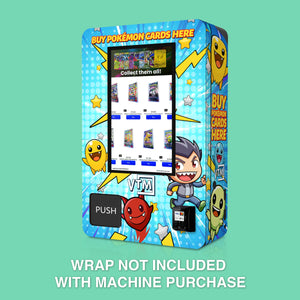
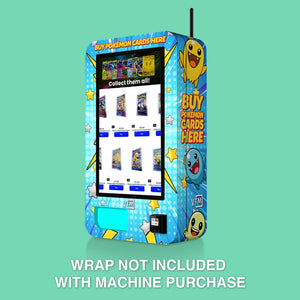
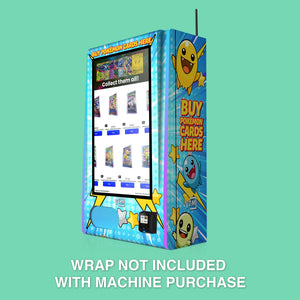
VTM operators are taking the digital rip experience and putting it in a physical machine. Instead of a virtual pack and a vaulted card, the customer pays at the machine and a sealed, graded slab drops into their hand. No app download, no shipping wait, no buyback paid in store credit.
The winning setup has four parts:
- Tiered aisles. Each price point is its own mystery pool, so a $30 aisle, a $45 aisle, and a $60 aisle each hold a different mix of slabs. Customers pick their level of risk.
- A mix of everyday slabs and chase slabs. Most of the pool is graded cards in the $10 to $20 cost range. A few high value slabs are seeded in as chase hits, and those hits are what keep people coming back.
- A visible hit board. Operators display the top slabs in each pool on signage or on the machine itself. Customers want to see what they could pull.
- The reveal moment. Collectors film their pulls and post them. Every big hit at your machine is free marketing for your location.


Examples of PSA 10 chase slabs.
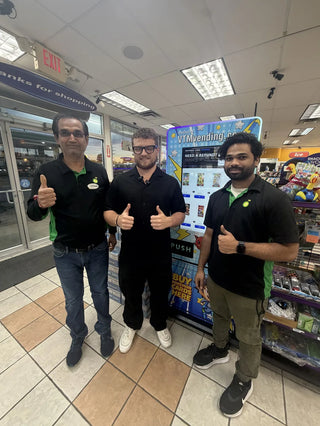
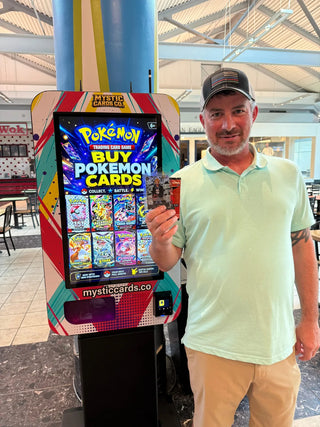
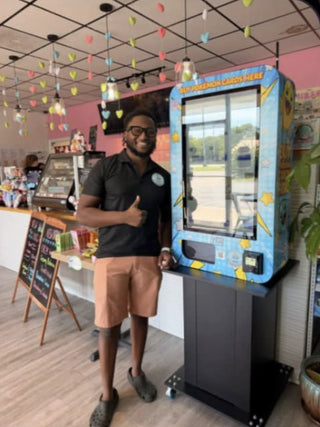
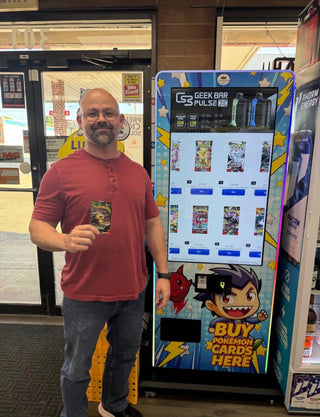
VTM's US hosted software and mobile app let operators see which tiers sell fastest, track every vend, and restock before a popular aisle runs dry. See real installs in our Pokemon install gallery.
The economics: how a slab machine reaches $10,000 a month
Some of the best VTM mystery slab locations are doing more than $10,000 a month in sales. Operators typically buy graded slabs for $10 to $20 each and vend them for $30 to $60, which puts the markup at roughly 2x to 3x cost.
Real numbers from July 2026. Across 10 VTM Pokemon machine locations, Mystery Graded Slab was a top three seller at 3 of them and the number one seller at one. Those machines also posted two of the three highest average vend prices in the group:
| July 2026 | Vends | Monthly revenue | Avg vend price | Top sellers |
|---|---|---|---|---|
| Location 1 | 62 | $1,338.40 | $21.59 | Mega Evolution, Mystery Graded Slab, Prismatic Evolutions |
| Location 2 | 41 | $1,137.61 | $27.75 | Ascended Heroes, Mystery Graded Slab, White Flare |
| Location 4 | 60 | $1,469.41 | $24.49 | Mystery Graded Slab, Mega Evolution, Surging Sparks |
Gross vend revenue before sales tax, July 1 to 31, 2026. Mixed Pokemon machines with packs and slabs; locations kept private. All 10 locations ranged from $531.71 to $4,739.43 for the month.


Here is what $10,000 in monthly sales takes at three common price points:
| Vend price | Avg slab cost | Gross margin | Vends for $10K/month | Vends per day | Gross profit on $10K |
|---|---|---|---|---|---|
| $30 | $15 | 50% | 334 | 11 | $5,000 |
| $45 | $15 | 67% | 223 | 7 to 8 | $6,667 |
| $60 | $20 | 67% | 167 | 5 to 6 | $6,667 |
At a $45 average vend, a machine needs only about 7 or 8 sales a day to cross $10,000 a month. Compared with a standard booster pack, each slab vend carries a higher ticket and a wider dollar margin.
These are illustrative figures, not a guarantee. Gross profit here is before payment processing fees, any location revenue share, and the extra cost of chase slabs seeded above the average. Results depend on location traffic, pricing, and how well the pool is curated.
How to launch a mystery slab vending machine

- Pick a location with collector traffic. Card shops, malls, family entertainment centers, arcades, and busy retail corridors all work. Foot traffic from people who already know Pokemon matters more than raw visitor counts.
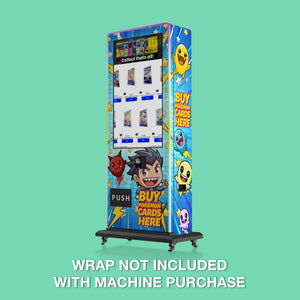
- Choose the right VTM machine. Match aisle count to the number of price tiers you plan to run. Our Pokemon Vending Guide walks through the options.
- Build your slab pool. Source graded slabs mostly in the $10 to $20 cost range, then set aside part of your budget for a handful of chase slabs.
- Set tiers and prices. Price each aisle between $30 and $60 based on the value of the pool behind it.
- Show off the hits. Put your best slabs on a hit board so shoppers can see what's in play.
- Track and restock from the app. Watch which tiers move, refill fast sellers, and pull slow movers.
- Refresh the pool. Rotate new slabs and new chase hits in regularly so repeat customers always have something new to chase.
If you already run booster packs, mystery slabs fit right alongside them. Dedicate a few aisles to slabs and keep packs in the rest. See current pack pricing in our Pokemon pricing guide.
Run it the right way
Mystery products sit close to gaming in the eyes of some regulators. Some jurisdictions have already tried to bring video game loot boxes under gambling rules, as Cointelegraph notes. The best operators stay well clear of that line:
- Every vend delivers a real collectible. A mystery slab is a purchase of a graded card, not a wager. Make sure every slab in the pool has genuine collectible value.
- Be transparent about the pool. Post what's in each tier and the range of values so customers know what they're buying.
- Market it as collecting, not betting. Avoid words like "bet," "odds," or "jackpot" on signage and social posts.
- Check your state and local rules. Requirements for mystery, prize, and promotional vending vary by state and city. Confirm the rules for each location before you install.
- Fit the location. Consider who walks past the machine and set any age guidance that fits the venue.
Frequently asked questions
What is a mystery graded slab vending machine?
It is a smart vending machine stocked with professionally graded trading cards sealed in protective slabs. The customer picks a price tier, pays, and receives a random graded card from that tier's pool.
How much can a mystery slab vending machine make?
Some of VTM's best mystery slab locations do more than $10,000 a month in sales. Results depend on foot traffic, pricing, and how well the slab pool is curated.
What do operators pay for graded slabs?
Operators typically source slabs for $10 to $20 each and vend them for $30 to $60, plus a smaller number of higher value chase slabs.
Is a mystery slab machine gambling?
Every vend delivers a real, graded collectible, which is the core difference from a wager. Rules on mystery and prize vending vary by state and city, so confirm local requirements before installing.
How is this different from online card rips like Courtyard?
Online rips reveal a card held in a vault that you ship home or sell back for credit. A vending machine hands the customer the physical slab in seconds, with no app and no shipping wait.
Can I sell mystery slabs and booster packs in the same machine?
Yes. Operators can dedicate some aisles to slab tiers and stock booster packs in the rest.
Start your mystery slab route with VTM
The demand is already proven online. VTM puts it in a machine you own. Every VTM machine comes with US hosted software, a mobile app with remote restart, experienced account executives, dedicated technical support, and a warranty.
Real operators run VTM. Talk to our team about the right trading card machine for your location, and start turning the thrill of the reveal into recurring revenue.